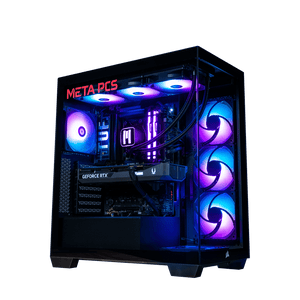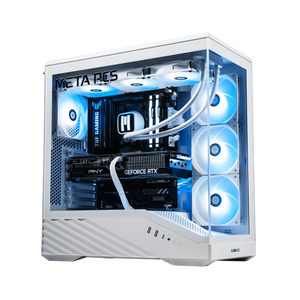





For most hybrid buyers in 2026, the sweet-spot build lands on an AMD Ryzen 7 9850X3D or 9800X3D, an RX 9070 XT or RTX 5070 Ti, 64GB of DDR5, and a 2TB NVMe drive. That's the spec that games hard at 1440p and doesn't stutter when you drop a video timeline on it. Stream to Twitch on the same machine and it holds up. Everything below is why that combination works, and what to do if your budget lands a tier below it.
What "gaming and work" means on the spec sheet
Two very different buyers ask us for a hybrid build. The creator profile is someone editing YouTube videos in DaVinci Resolve or Premiere. It might also mean streaming to Twitch with OBS on the same machine, or handling Photoshop and Lightroom work during the day. They need a GPU strong enough to game and a CPU that can encode a stream while gaming, backed by enough RAM to keep an editing timeline responsive when a game is also in memory.
Then there's the professional. The developer who clocks out at 6 and clocks into a raid at 7. Or the engineer running Docker containers during the day who wants to alt-tab into Marvel Rivals for an hour after work. This buyer needs enough memory to keep the work state resident so switching back and forth doesn't drag the whole system down.
Two very different day jobs land on the same parts list. A workstation-first setup (Threadripper class with pro GPUs and ECC) handles the work but games poorly. We spec gaming-first machines that hold up on both sides.
The CPU is the pivot point, and X3D is why
AMD's X3D chips are the reason a gaming-first build can hold up in productivity work. The Ryzen 7 9850X3D lands in the sweet spot for a hybrid buyer. Eight cores with 3D V-Cache stacked on top gives you gaming performance at the top of the market. The multi-thread grunt on top of that is enough to render short-form video or push a stream encode while you play.
Stepping up to a Ryzen 9 9950X3D buys 16 cores, which pays off for rendering or CPU-bound simulation workloads. In games, the difference sits inside margin of error. AMD's newer Ryzen 9 9950X3D2 Dual Edition (April 2026, $899) sits above the 9950X3D with 3D V-Cache on both chiplets and 208MB total cache. That's the current 16-core flagship for cache-heavy productivity work. Both 16-core options are overkill for most hybrid buyers. The 9850X3D is where most land because those extra cores don't earn their price back at the mixed workload they actually run. If your day is Premiere or Blender-heavy for hours, either step-up chip earns its price. Otherwise, the 9850X3D is the smarter spend.
Where the X3D approach hits its ceiling is heavy long-form rendering or serious 3D animation. Cinebench R24 multi-thread on the 9850X3D lands in the mid-1300s across independent testing, which is enough for the workloads most hybrid buyers run but not the number you want if your day is thirty-minute Blender renders on complex scenes. Anyone in that camp is looking at a Ryzen 9 or actual workstation chip, which our custom PC builder handles.
Why 64GB is the RAM number for a hybrid build
Our RAM sizing guide lays out why 32GB is the floor for a pure gaming PC in 2026. Hybrid buyers move up one tier for a specific reason. Both workloads want the RAM at the same time.
Let's get into some numbers. A modern UE5 game like Black Myth: Wukong or Stalker 2 can pull 16GB or more on the game alone at higher settings. Windows 11 idle sits around 5GB. OBS adds another 2GB while you're live. Chrome with a real tab load takes 3GB. Discord runs about a gig. Add DaVinci Resolve with a modest project open (call it 8GB) or Docker running a couple of containers (another 6GB or so), and you're at 40GB in flight before the day gets busy.
32GB is fine for gaming alone. It starts to strain once you keep a full work state resident behind it, and once you're swapping to the SSD both the game and the timeline stutter. 64GB is the number that lets both breathe. A 32GB DDR5-6000 kit runs around $400 on Tom's Hardware's RAM price tracker as of mid-2026, and 64GB stock is thin, which our RAMageddon buying guide digs into. RAM is where we'd cut last on a hybrid spec.
GPU: RX 9070 XT vs RTX 5070 Ti for a hybrid buyer
Two cards do the hybrid job well in 2026, and the right pick depends on the specific work you're doing.
The AMD RX 9070 XT is the value pick and the one we built the video around. It goes toe-to-toe with the RTX 5070 Ti in raw rasterization for less money and holds 1440p high refresh comfortably. It'll do 4K/60 in most current AAAs when you lean on FSR 4 or turn ray tracing off. In the video's build, Cyberpunk 2077 at 4K Ultra without ray tracing ran 62 fps average with a 51 fps 1% low on the 9070 XT paired with the 9850X3D. Fortnite at 1440p high cleared 391 fps average.
The RTX 5070 Ti earns its higher price for a specific pipeline. That means CUDA-accelerated work (a lot of AI and ML tooling, older DaVinci Resolve plugins) and NVENC encoding at higher bit depths for streaming. Studio drivers add another layer of stability for creative apps that need it. Pricing on the 5070 Ti has climbed alongside the rest of the RTX 50 stack per Tom's Hardware's live GPU tracker, so the 9070 XT's value advantage has widened this year.
For an AMD-friendly creative stack (Premiere, current DaVinci, Blender), the 9070 XT is the pick and the savings go into RAM or storage. The 5070 Ti earns its extra cost the moment your day depends on CUDA acceleration, or if you're streaming heavily on Twitch and want NVENC's higher bit depths in the encode.
The parts hybrid builds skimp on
Storage is where hybrid workloads hit hardest. Game asset streaming, video scrub timelines, project files, source footage, and the OS all fight for read and write bandwidth. 2TB of Gen 4 NVMe is the minimum we spec here. A single Gen 4 drive holds a working project set and a game library alongside Windows without breaking a sweat. A 1TB drive fills up in a month if you're editing at 4K, and once it's full the swap-to-secondary-drive dance kills your workflow.
Now the depressing part: the PSU. A 9850X3D pulls up to 200W under load and the 9070 XT sits at 304W board power with spikes higher than that. Add another 70W or so for the rest of the machine and you're around 575W steady before headroom. An 850W 80+ Gold PSU keeps that around 68% load with real headroom for transients. Cheap PSUs on cards this hungry are one of the more common warranty tickets we see. A proper PSU with headroom avoids that entirely.
Cooling is the last piece. A 360mm AIO on the CPU isn't a luxury on a workstation-adjacent build. Long rendering runs push a CPU harder for longer than a game does, and the difference between a 240mm and a 360mm shows up as sustained clock speeds during a 20-minute render or a full-length Blender scene. Under an OCCT run on the video's build the 9850X3D peaked at 91.75°C on the 360mm cooling. That's within spec but on the edge, and a smaller cooler would push it further.
What we build for the hybrid buyer
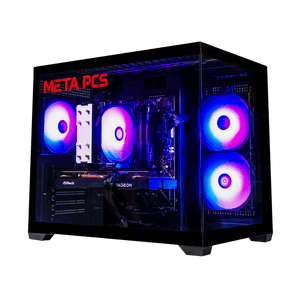
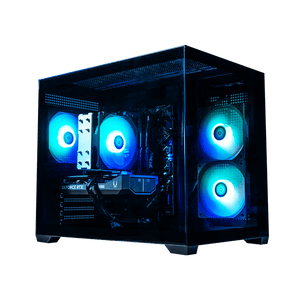
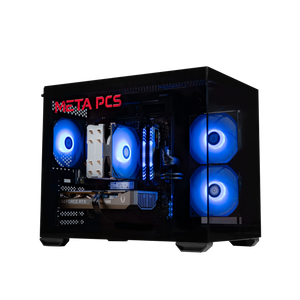
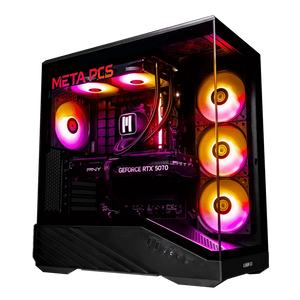
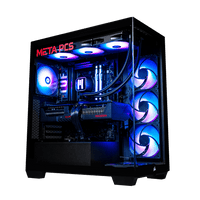
For the NVIDIA path, our TROOPER is the ready-to-ship match. Same Ryzen 7 9850X3D as the video's build, paired with an RTX 5070 Ti and 32GB of Kingston Fury DDR5-6000. It ships tested and configured out of the box for hybrid work, on lifetime US-based support. If you want the full 64GB kit we recommend above, dropping the RAM upgrade in at checkout is the cleanest path.
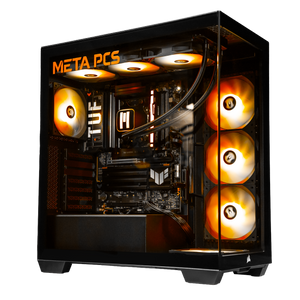
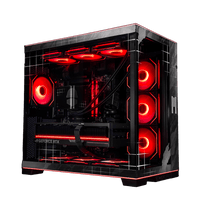
For the AMD path we built in the video (Ryzen 7 9850X3D, RX 9070 XT, 64GB DDR5), the custom PC builder is where that lives. You pick every part and we handle the assembly and stress-testing. Same lifetime US-based support as our ready-to-ship rigs.
For the mid-tier buyer who doesn't need the top X3D chip, the Nightwalker v2 runs a Ryzen 7 7800X3D with the same RX 9070 XT and 32GB of DDR5. It handles 1440p high-refresh gaming and light creative work at a lower price than the 9850X3D builds. Not a full hybrid workhorse, but a solid entry point.
Frequently asked questions
Is a gaming PC good for work in 2026?
For most work, yes. An X3D chip paired with a modern GPU and 64GB of DDR5 handles video editing, streaming, developer workloads, and creative apps without the compromises a Threadripper workstation forces on your gaming experience. The exception is heavy long-form rendering (8K video or complex 3D animation), where a higher-core-count CPU or a proper workstation earns the money.
Do I really need 64GB of RAM for a gaming and work PC?
Yes, if you actually run both workloads at once. Hybrid users end up with the game plus a full work stack in memory together (browser tabs, Discord, stream encoder, creative apps), which routinely lands in the 40GB range and starts pushing 32GB systems to swap.
Should I go AMD or NVIDIA for a hybrid gaming and creator build?
AMD's RX 9070 XT is the better value for a hybrid buyer whose creative work runs on AMD-friendly apps (current Premiere, DaVinci Resolve, Photoshop, Lightroom, Blender). NVIDIA's RTX 5070 Ti earns its extra cost if you rely on CUDA acceleration or if high-bit-depth NVENC streaming is core to your workflow.
What's the difference between a gaming PC and a workstation?
Workstations run higher-core-count chips like Threadripper or Xeon. They pair those with certified pro GPUs and ECC memory built for reliability under long sustained workloads. Gaming PCs use consumer parts tuned for burst performance and high refresh rate instead. A hybrid build lives in the middle. It runs a gaming-first CPU that can also grind through render work, paired with a consumer GPU that handles creative apps well. 64GB of RAM keeps both sides resident at once.
Can I stream and game on the same PC in 2026?
Yes, with the right spec. An X3D chip handles the game while the GPU encoder (NVENC on NVIDIA, AMF on AMD) handles the stream in hardware, freeing the CPU to keep frame rates high. 64GB of RAM gives OBS or Streamlabs room to run alongside the game without swapping. Both encoders in 2026 produce broadcast-quality streams at Twitch's 6 Mbps cap for non-partners, and higher bitrates on YouTube.
Ready to build
Back to the spec at the top: 9850X3D, 9070 XT or 5070 Ti, 64GB, 2TB NVMe. That's what we build most often for the customer who won't tell you they game until the second call. Pure gaming builds and pure workstations each miss on this buyer for different reasons, and the middle-ground spec is the one that actually earns its money.
If a 9850X3D-based build is what you want, the TROOPER ships that chip on the NVIDIA side and our custom builder handles the AMD side with the full 64GB kit. Not sure the tier is right? Our 1440p buying guide covers the resolution most of these builds target, and the 4K gaming guide walks through when the extra pixels are worth the tax. Our Best Prebuilt Gaming PC guide is where to start on what separates a good prebuilt from a bad one at any tier. Every META PCs system ships tested and on lifetime US-based support. When yours lands, here are the first six things to do before you launch a game or open a project file.