




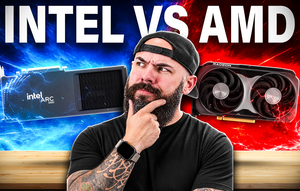
The budget GPU market finally got interesting again in 2026. Intel has a low-end card people actually recommend, AMD's RDNA 4 refresh landed hard, and NVIDIA has priced itself out of anything a budget builder would look at twice. For a 1080p build on a tight budget it really comes down to two cards, the Intel Arc B580 and the AMD Radeon RX 9060 XT 16GB, and for most people the B580 is the value pick. The 9060 XT is the one worth paying up for if you care about ray tracing or plan to move to 1440p later on.
The rest of this is the why, built on real 2026 street prices, benchmarks, and the things that matter once you're past the spec sheet.
Quick reference: Arc B580 vs RX 9060 XT 16GB
| Category | Intel Arc B580 | AMD RX 9060 XT 16GB |
|---|---|---|
| Current retail price | $290 to $310 | $400 to $450 |
| VRAM | 12GB GDDR6 | 16GB GDDR6 |
| Memory bus | 192-bit | 128-bit |
| TDP | 190W | 160W |
| Recommended PSU | 600W | 550W |
| Upscaling stack | XeSS 2 with Frame Gen | FSR 4 with Frame Gen |
| Raw 1080p performance | Baseline | 10% faster on average |
| Ray tracing performance | Weaker | Notably stronger |
| Older DX9 / DX11 game compatibility | Occasional issues | Fully mature |
Why it comes down to these two
Quick bit of context before the head-to-head. Three cards live under $500 right now: the B580, the RX 9060 XT in its 8GB and 16GB versions, and NVIDIA's RTX 5060. The 5060 is a competent card, but it sits at $340 with only 8GB of VRAM, which is a rough spot to be in against a $300 B580 carrying 12GB. So it drops out of the conversation fast, and you're left choosing between Intel's entry card and AMD's card one rung up.
The benchmark chart isn't the whole story at this tier. Price decides most of it, then VRAM headroom, then how the drivers behave across the specific games you play, then upscaling coverage. Both cards game well at 1080p. Which one is right for you depends on how you weigh those four.
Where the B580 makes more sense
Start with the money, since that's what settles it for most buyers. The B580 runs right around $300 at the major retailers as of mid-2026. The 9060 XT 16GB is closer to $450, or $400 if you catch a promo. Call it $150 between them at typical pricing. On a budget build, $150 is a full 16GB RAM kit's worth of savings, or most of a solid 240mm AIO cooler. None of that is rounding error.
The 12GB buffer is the other half of it. 8GB has quietly turned into a problem at this tier, since modern games with high-res textures blow past it and start stuttering. The B580 gets you 12GB for around $300, the cheapest way out of 8GB jail this year. It stays composed in texture-heavy games where the RTX 5060 and the 8GB version of the 9060 XT, both priced about the same, start choking.
And the driver's reputation is out of date. Intel's Arc drivers were rough when Alchemist launched a few years back, and that memory has outlived the actual problem. Battlemage shipped on a far more stable stack, and the monthly updates through late 2025 and 2026 cleaned up most of what was left. Tom's Hardware's review called the drivers much improved over the first Arc generation and hit no real show-stoppers in testing. DX12 and Vulkan games behave like they would on any mainstream card. The rough edges that remain are in older DX9 and DX11 titles, so a library full of legacy games is the one case where you'd stop and think.
Where the 9060 XT earns the extra money
Now the other direction. A few things pull people toward the AMD card, and the first is the one the B580 can't answer.
Ray tracing is the clearest gap. Switch on RT in Cyberpunk 2077, Alan Wake 2, Indiana Jones and the Great Circle, or most current AAA releases, and the 9060 XT pulls away by more than the roughly 10% it leads by in raster. RDNA 4 made real gains here. In the heaviest RT scenes, that gap stretches well past what an average benchmark implies.
The 16GB buys you room to grow. You might be on a 1080p panel today, but monitors get upgraded, and the extra 4GB is what lets the card stretch into 1440p and light 4K without slamming into a memory wall. Tom's Hardware's testing puts it at just under 100 fps at 1080p and 67 at 1440p across a modern suite. That's real 1440p performance, not the occasional-spike kind the B580 can touch but not hold.
FSR 4 also covers more ground than XeSS. AMD's upscaler runs in more current games than Intel's, and FSR 4 closed most of the quality gap with DLSS. If your backlog leans on newer AAA titles that shipped with upscaling baked in, you'll get broader, steadier coverage on the AMD card. Intel's XeSS 2 with frame generation is good where it shows up. It just shows up in fewer games so far.
The bottom line for a 1080p buyer
For most people building at 1080p, the B580 is the smarter buy, full stop. You get 12GB of VRAM, performance within 10% of a card that costs $150 more, and that difference back in your pocket for the rest of the build. In a year where a 16GB RAM kit alone runs $200, that's not a number you wave off.
The 9060 XT flips the math in specific cases. Play ray-traced games regularly, sit on a 1440p panel or plan to move to one, run a backlog full of older DX9 and DX11 games where AMD's driver history is smoother, or want the 16GB for creative work alongside gaming, and the extra spend pays for itself. Outside those cases, the B580's value is hard to argue with.
What we ship at the shop
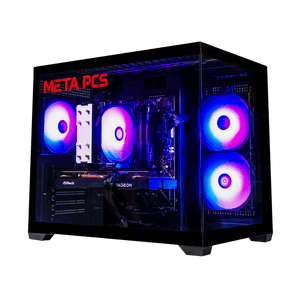
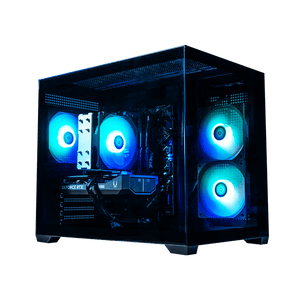
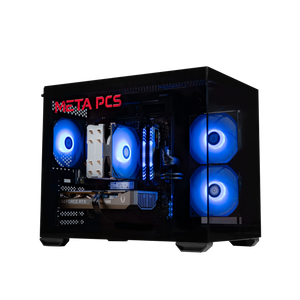
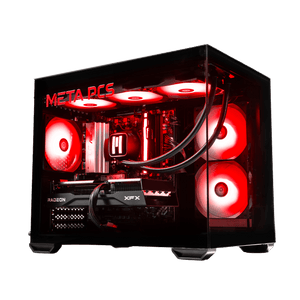
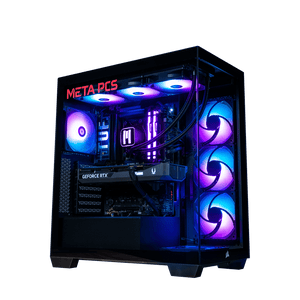
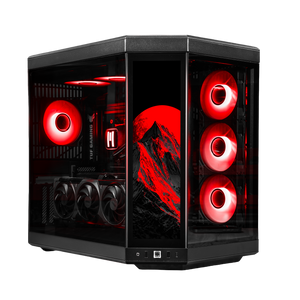
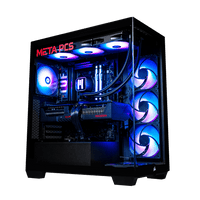
If the 9060 XT is the card that fits you, we build it into the SHADE v3, assembled and stress-tested before it ships. It runs the 9060 XT 16GB with a Ryzen 5 9600X, 16GB of DDR5, a 1TB NVMe, and a 240mm META AIO in a standard ATX case, and it lands right at the top of our mid-tier bracket. The full lineup is on our ready-to-ship page.
We don't stock a B580 build in the ready-to-ship range at the moment. If that's the route you want, our custom PC builder is where to start one, with no parts-sourcing or assembly on your end.
Every system leaves the shop tested, on lifetime US-based support, and built with an upgrade path in mind so a stronger GPU drops in two or three years out without touching the rest of the machine. If you're weighing prebuilts more broadly, our Best Prebuilt Gaming PC guide covers what separates a good one from a bad one, whatever GPU tier you land on.
FAQ
Is the Arc B580 good for 1080p gaming in 2026?
Yes, without issue. It runs modern AAA titles at high to ultra at 1080p and clears 100 fps in most esports games. It trails the 9060 XT 16GB by about 10% on average, but it's $150 cheaper and carries 12GB of VRAM, which is the combination most 1080p buyers want.
Does the Arc B580 have driver problems?
Not like the old Alchemist cards did. Battlemage launched on a much better driver stack and has picked up monthly updates since. DX12 and Vulkan games run clean. Where you'll still trip is older DX9 and DX11 titles, some Source engine games, and the odd legacy release. For a current library, it's stable.
Which is better for streaming, the Arc B580 or RX 9060 XT?
Both handle AV1 encoding and both stream fine. Intel's media engine has always been strong on encode quality, and AMD's caught up with RDNA 4, so for occasional streaming alongside your gaming, either one works. If you stream full-time with a heavy encode workflow, the 9060 XT's bigger VRAM buffer and more mature OBS support give it a small edge.
Should I wait for the next generation of budget GPUs?
Depends what you're waiting on. Intel has one more Battlemage card coming, the Arc B770, reportedly due late 2026 with 16GB, but it's a tier up in price and performance, not a cheaper B580. Past that, Intel's next architecture isn't expected before 2027, AMD's next mid-range is a 2027 story at best, and NVIDIA sat out 2026 for new gaming cards entirely. If you need a GPU in the next year, today's pricing beats waiting for cards that won't land until deep into 2027 and will almost certainly launch higher, given where memory has gone.
Ready to build
The takeaway is simple enough. For a 1080p budget build in 2026, the B580 is the value pick, and the 9060 XT 16GB is worth the extra $150 if ray tracing, a 1440p upgrade, or an older-game library is in the picture.
Want the 9060 XT 16GB already built and tested? Our ready-to-ship SHADE v3 is the direct route. If you'd rather run a B580 or spec something different, the custom PC builder handles that. Either way it ships tested and on lifetime US-based support. And when your build shows up, here are the first six things to do before you load a game.