




Building your own gaming PC used to be an easy call. You saved a couple hundred bucks, you learned something, you got exactly the parts you wanted, and if anything broke you knew how to fix it. That's the math that made DIY the default for anyone with the confidence to try. Except in 2026, that math is different, and it's not because prebuilt companies got better. It's because the parts market got worse.
RAM prices climbed nearly 89 percent in a single quarter this year, NVIDIA skipped their entire 2026 gaming lineup, and AMD's already warned that a second GPU price hike is coming. When component pricing gets this weird, the DIY savings shrink or disappear altogether. And once the numbers get close, the other stuff (warranty, time, DOA risk, having someone to actually call when something goes wrong) starts mattering more than it used to. Here's the honest breakdown of when a prebuilt is the smarter call in 2026 and when you should still build it yourself.
Quick reference: DIY vs prebuilt in 2026
| Total cost (comparable specs) | $1,120 to $1,400 in parts alone | $1,299 finished |
| Warranty | Manufacturer warranty per part only | Lifetime US-based support on the whole system |
| Assembly time | 8 to 15 hours (first-time builders longer) | Ships assembled and tested |
| Risk of DOA parts | 3 to 5 percent per component | Absorbed by the builder |
| OS included | You install and configure the OS yourself | OS pre-installed and tuned (SteamOS or Windows depending on build) |
| Parts availability risk | Multiple retailers, individual back-orders possible | One point of contact, one shipment |
What actually changed in 2026
The whole reason DIY math was reliably cheaper for the last decade was that you could source individual parts at aggressive retail prices and avoid the margin that system integrators built into their prebuilt lineups. That model breaks when the parts themselves are pricing at or near what integrators charge for the whole finished system. And that's exactly where we've landed this year. A 32GB DDR5-6000 kit that ran $80 to $120 in mid-2025 now runs $400 or more, per Tom's Hardware's live RAM price tracker. We covered the full memory shortage picture in our RAMageddon buying guide if you want the deeper backstory.
On the graphics card side, NVIDIA skipping 2026 entirely for new gaming GPUs kept the RTX 5000 series as the current high-end lineup, and pricing on those cards stays elevated because supply is constrained. AMD's Radeon RX 9000 series is holding a bit steadier, though AMD has warned their board partners about a second price hike of at least 10 percent coming across the product line.
The result is that parts sourcing in 2026 costs more in three ways: the parts themselves are more expensive, availability is worse (some components are backordered for weeks at retailers), and the second-hand market has adjusted upward alongside new prices, so used isn't the escape hatch it usually is. All three of those pressures hit DIY builders harder than they hit prebuilt companies buying at wholesale volumes.
The real cost of building yourself in 2026
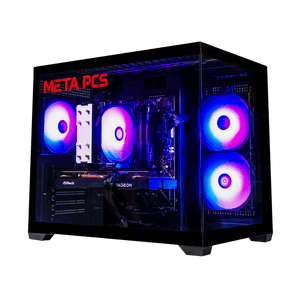
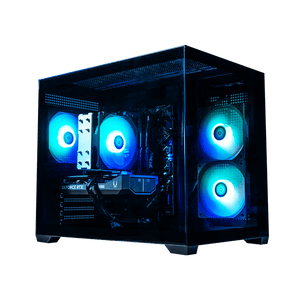
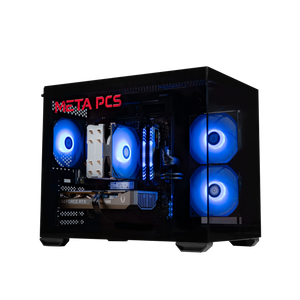
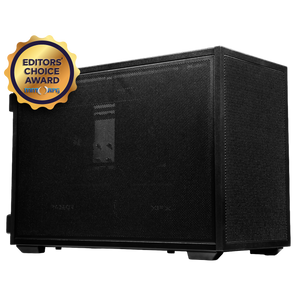
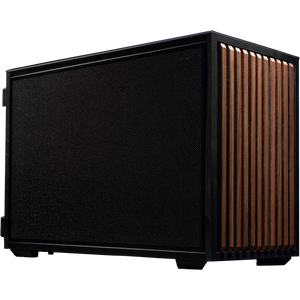
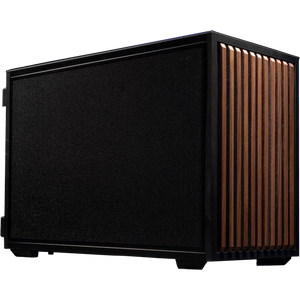
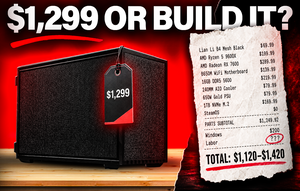
Let's price out an actual DIY equivalent to our entry-level prebuilt so the numbers are concrete instead of theoretical. The Steamroller v3 ships with a Ryzen 5 9600X, an RX 7600, 16GB of DDR5-5600, a 1TB NVMe SSD, a 240mm AIO cooler, and a 750W-plus PSU inside a Lian Li B4 chassis. Total price is $1,299 assembled, tested, and shipped with lifetime US-based support.
Now the DIY math for the same specs, based on current 2026 retail pricing:
Ryzen 5 9600X: about $200 to $220. RX 7600: about $260 to $290 depending on the model. 16GB DDR5-5600 kit: about $200 to $250 (single-stick options are cheaper but leave you at single-channel). 1TB NVMe Gen 4 SSD: about $70 to $90. AM5 B650 motherboard: about $130 to $180 for something that will actually last the socket's lifespan. Case comparable to the Lian Li B4: about $80 to $110. 240mm AIO cooler: about $80 to $120. 750W-plus 80 Plus Gold PSU: about $100 to $150.
The parts total lands somewhere between $1,120 on the low end and $1,410 on the high end. That does not include the time you'll spend researching parts compatibility, waiting for delayed shipments, assembling, troubleshooting, and installing the OS. First-time builders often spend 12 to 15 hours on that whole process. Even experienced builders spend 8 to 10 hours minimum.
So the real all-in cost of DIY can match or even exceed the price of a prebuilt once you factor in part quality choices, the time you'll spend building it, and any OS you need to buy. The prebuilt lands right in that same range at $1,299 with none of the risk.
What a prebuilt actually includes at those specs
The Steamroller v3 at $1,299 is not just "the parts, but assembled." A few things are worth pricing out because they're often invisible until something goes wrong.
Lifetime US-based support means if a component fails in year three, we're the ones handling the RMA with the part manufacturer, not you. You call us, we handle it. When you build yourself, every failed part is a separate warranty claim with a different company, on their timeline, with their return policy.
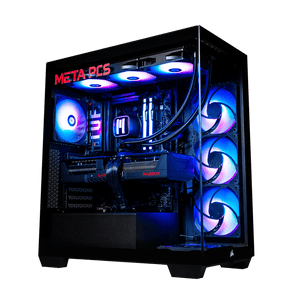
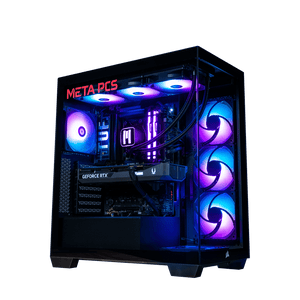
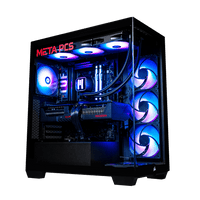
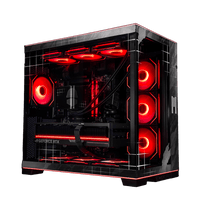
The OS pre-installed and tuned to the hardware means the machine is ready to game the moment it arrives. If you want SteamOS specifically, our Steamroller v3 ships with it out of the box. If you'd rather have Windows at the same price point, our Ember Ti at $1,299 ships with Windows 11 pre-installed. Either way, no drivers to hunt down, no BIOS updates to figure out, no OS install to sit through. That's real time saved regardless of which OS you want.
Assembly quality that's tested before shipping. Every prebuilt we ship gets stress tested, thermal-checked, and burn-in tested before it leaves the shop. DIY builds skip all of that unless you set up the testing yourself. We covered what actually separates a good prebuilt from a bad one in our Best Prebuilt Gaming PC guide, which is worth reading if you're evaluating multiple prebuilt options.
Standard ATX parts and full upgrade path. The Steamroller v3 uses a standard ATX motherboard, standard PSU, and a case that fits any GPU you'd realistically want to add later. When you upgrade the GPU or drop in a Ryzen 7 X3D two years from now, nothing about the prebuilt makes that harder than it would be on a DIY build. That's not true of every prebuilt on the market.
When building yourself is still the right call
A few scenarios where DIY still wins, even in this market.
If you actually enjoy the build process, that changes the whole calculation. The satisfaction of researching parts, assembling the machine, tuning your first boot, and seeing your own build come to life is real. That's worth something if you're the kind of person who wants that experience. Nobody buys a prebuilt because they love hardware for its own sake.
If you have very specific parts requirements that don't match a shipped configuration. Some builders want a particular motherboard for a specific chipset feature, or a case with a specific aesthetic, or an unusual cooling configuration. Prebuilts can't cover every niche. If your build is niche, DIY is still the answer.
If you're building at a truly rock-bottom budget under $900. Prebuilt margins get compressed at the very bottom of the market, and DIY still gives you some flexibility to shop sales aggressively and pick up used parts. Above roughly $1,200 the math tightens up and prebuilt becomes competitive or better. Below that, DIY can still save you $100 to $200 if you're patient. If you're going that route, our First 6 Things guide covers what to do after the build is done.
When a prebuilt is the smarter call in 2026
The scenarios where prebuilt wins in this specific market.
If you don't want to spend 10-plus hours researching, sourcing, and building. Time is a real cost, and for most people the hours a DIY build takes are worth more than the couple hundred dollars they might save. Prebuilt buys you those hours back.
If you want a single point of contact for support. When something breaks on a DIY build, you're doing warranty claims across five different manufacturers. On a prebuilt with lifetime support, one call handles the whole system. That's the difference between a two-hour phone call and a two-week email chain.
If you're specifically looking at the $1,200 to $2,500 range. This is where the math is tightest and where prebuilts compete on total cost with sourced parts. Our Steamroller v3 at $1,299 sits right at the entry point of that range, and the higher-tier builds in our ready-to-ship lineup cover the rest of it.
If you're a first-time buyer. Building a PC as your first experience with hardware is a real learning curve, and "figuring it out" during a $1,500 build with 2026 pricing on every part is a high-stakes way to learn. A prebuilt lets you skip the learning curve on this purchase and pick up the knowledge later on smaller upgrades.
If parts availability is blocking you. This one keeps coming up in 2026. Several parts have been intermittently backordered at major retailers for weeks at a time. Prebuilt companies buy at wholesale volumes and can source through channels that individual buyers can't access, so "waiting for the part to be back in stock" isn't the same problem for us as it is for a DIY builder.
FAQ
Is it cheaper to build a PC or buy prebuilt in 2026?
At comparable specs, DIY parts cost between $1,120 and $1,400 for an entry AM5 gaming build. A prebuilt at the same specs lands around $1,299. Once you add shipping across multiple retailers and time value, the numbers are effectively tied. In 2024 or 2025, DIY was clearly cheaper. In 2026, it depends on how much you value your time and how comfortable you are managing warranty claims across five manufacturers.
Do prebuilt gaming PCs come with a warranty?
Depends heavily on the brand. Big-box retailer prebuilts usually ship with a one-year manufacturer warranty on the whole system. Custom shop prebuilts vary from one-year all the way up to lifetime coverage on components. Our systems ship with lifetime US-based support on every build, which means if something fails five years from now, we're still the ones handling it. That's not standard across the industry.
Are prebuilt PCs upgradable?
Good prebuilts are. Bad ones aren't. The signs of a bad one are proprietary parts, non-standard PSU form factors, cases that can't fit modern GPU sizes, and motherboards on dead-end sockets like AM4 or LGA 1200 that force you to replace half the system to upgrade the CPU. Every prebuilt we ship uses standard ATX parts, is on the current-generation AM5 socket, and has room in the case for any GPU you'd realistically add later.
Should I buy prebuilt if I've never built a PC before?
Yes, in most cases. First-time builders spend the most hours per build and take the biggest hit from mistakes, and 2026 is a bad year for mistakes given how expensive replacement parts are. A prebuilt gets you a working gaming PC without any of the first-build risks, and you can pick up the hardware knowledge over time by doing your own upgrades later, when a single mistake costs $60 instead of $600.
Ready to build
The short version: in 2026, DIY still makes sense if you love the build process, need a niche configuration, or are working with a tight sub-$900 budget. For everything else, prebuilts are competitive or better on total cost once you account for warranty, time, and the parts market getting weird.
Our ready-to-ship builds cover the full range from entry-level $1,299 (SteamOS on the Steamroller v3, Windows 11 on the Ember Ti) to flagship configurations, and every system ships assembled, tested, and backed by lifetime US-based support.